


Dubai Tenant Checklist: Viewing, Ejari, DEWA, Gas & Internet
A step-by-step checklist for renting an apartment, townhouse or villa in Dubai: what to check at viewings, what to confirm before you sign, and how to set up Ejari, DEWA, gas and internet.
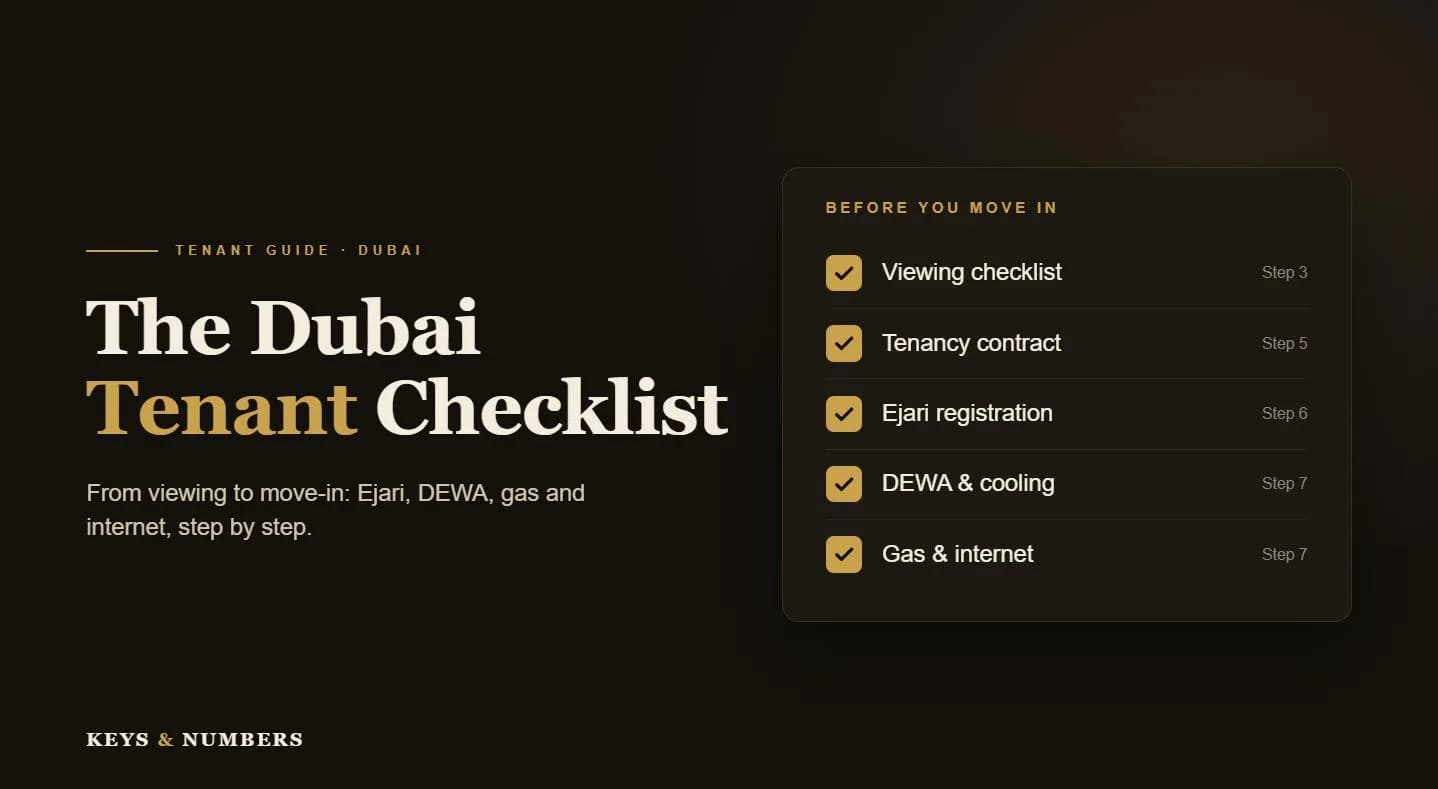
Renting in Dubai: the whole process at a glance
Set your budget and must-haves
Search and shortlist
View the property with a checklist
Negotiate and agree the terms
Sign the tenancy contract and pay
Register Ejari
Set up DEWA, cooling, gas and internet
Move in, document the condition and settle in
Most of the delays tenants run into come from doing these out of order. Ejari comes before DEWA, and DEWA comes before almost everything else. This guide walks through each step with a checklist you can tick off.
Step 1: Set your budget and must-haves
☐ Decide your annual rent ceiling. Most Dubai landlords ask for 1 to 4 cheques, so check what you can comfortably pay upfront.
☐ Add the one-off costs on top of rent (see the cost table below) so your first-month cash need is not a surprise.
☐ Decide property type: apartment, townhouse or villa.
☐ List your non-negotiables: bedrooms, parking, pet policy, commute, school catchment, and furnished or unfurnished.
☐ Decide your move-in date and your notice deadline at your current home.
Step 2: Search and shortlist
☐ Use only licensed agents. Ask to see their RERA broker card and check the listing carries a valid permit number.
☐ Ask the agent to confirm the landlord or authorised representative, and ask for the title deed or Power of Attorney.
☐ Compare the asking rent with similar homes in the same building or community. Ask the agent for recent examples.
☐ Shortlist three to five homes and book viewings on the same day where you can, so you can compare while fresh.
Browse current homes on our For Rent page, or book a consultation and we will shortlist for you.
Step 3: What to check at the viewing
Photos hide a lot. Take your phone and check these in person.
Inside the home
☐ Air conditioning: is it split, central or district cooling? Turn it on and check it cools properly and is not noisy. Ask who pays for chiller or cooling charges.
☐ Water pressure and hot water: run the taps and the shower, and flush every toilet.
☐ Signs of leaks or damp: ceiling stains, peeling paint, musty smell, bathroom grout and under-sink cupboards.
☐ Windows, doors, locks and balcony doors: do they open, close and lock properly?
☐ Electrical: test sockets and switches and look at the distribution board.
☐ Kitchen and appliances: check what is included and that the ones included work (oven, hob, extractor, fridge, washing machine).
☐ Storage, wardrobes and layout: will your furniture actually fit?
☐ Mobile signal and Wi-Fi: check reception in each room, and ask which internet providers cover the building.
The building and the neighbourhood
☐ Parking: is a space included, how many, and is there visitor parking?
☐ Lifts, lobby, gym and pool: are they clean, working and open to residents?
☐ Noise: visit at the time you would be at home. Check construction, traffic, flight paths and neighbours.
☐ Sunlight and view: which way does it face, and will the view stay open?
☐ Commute and daily needs: drive or ride the route to work, and check supermarkets, schools, metro and clinics.
☐ Security: gated access, CCTV, concierge or guards.
☐ Villas and townhouses: garden size and irrigation, roof and outdoor taps, maid's room, and community rules on pets and extensions.
Ask the landlord or agent
☐ Is the property vacant now, and on what date can you move in?
☐ Is gas allowed, and is it central gas or cylinders?
☐ What are the building's move-in rules, fees and permitted move-in hours?
☐ Is the unit being sold or planned for renovation?
Step 4: Negotiate and agree the terms
☐ Rent, number of cheques and payment dates.
☐ Security deposit. In practice it is commonly 5% of annual rent for unfurnished and 10% for furnished, but agree it in writing.
☐ Agency commission: usually around 5% of annual rent, often with a minimum fee. Confirm who pays and how much before you pay anything.
☐ What the landlord will fix or paint before you move in, and by when. Get it in writing.
☐ Furnishing and appliance inventory, if any.
☐ Maintenance: who handles what. Landlords generally handle structural and major system repairs unless the contract says otherwise.
Step 5: Review and sign the tenancy contract
Read the contract before you sign, not after. Check:
☐ Names and Emirates ID details of tenant and landlord, and the property details (unit number, plot or building, premises number where shown).
☐ Contract dates, annual rent and cheque schedule, matching what you agreed.
☐ Security deposit amount and when it will be returned.
☐ Early termination terms and notice period. If the contract says nothing, you may face a penalty, so negotiate this now.
☐ Rules on subletting, pets, decorating and changes to the property.
☐ Maintenance responsibilities, and any chiller or service charges that fall on you.
☐ Renewal terms. Landlords who want a rent increase must follow the rules, including written notice at least 90 days before the contract ends, and increases are linked to the RERA rental index.
Keep a copy of the signed contract, the cheques you issued, receipts for the deposit and commission, and the landlord's ID and title deed copies.
Step 6: Register Ejari
Ejari is Dubai's tenancy registration system and the document most other services ask for. Register it first, because DEWA, district cooling, and many internet and gas providers will ask for your Ejari certificate or number.
What you need
☐ Signed tenancy contract
☐ Security deposit receipt
☐ Tenant's Emirates ID and passport (as required)
☐ Landlord's title deed and ID copies
☐ DEWA premises number for the unit
How to do it
Online through the Dubai REST app: open Services, then RERA, then Register Ejari Contract. Enter the details, upload documents, and submit. The landlord approves the request in their own account. You pay the fee and the certificate is issued.
In person at a registered Real Estate Services Trustee Centre, which charges a bit more because of its service fee.
Cost and timing: fees depend on the channel. Published figures for 2026 range from roughly AED 155 to 220 including fees, so check the current amount in the Dubai REST app. Online registration can be issued the same day, and a trustee centre usually takes one to two working days.
Do not skip it. An unregistered tenancy can weaken your position if there is ever a dispute. The landlord is normally responsible for registering within 30 days of signing, but as the tenant you should confirm it is done.
Step 7: Set up your utilities
Do these in this order.
DEWA (electricity and water)
☐ Have your Ejari number, Emirates ID, passport and visa copies and your tenancy contract ready.
☐ Apply through the DEWA website or app and pay the activation charges and the refundable security deposit. Typical published amounts: AED 2,000 for an apartment and AED 4,000 for a villa, plus a small activation fee.
☐ Activation usually follows within about a day of payment.
☐ Expect the Dubai Municipality housing fee to appear on your DEWA bill. It is 5% of annual rent, spread across the year.
District cooling (if your building uses it)
☐ Ask the landlord whether cooling is included in the rent. If not, register with the provider (for example Empower or Tabreed).
☐ Expect a connection fee, an administration charge and a security deposit, which vary by provider and property.
Gas
☐ Confirm gas is allowed in the building. Some towers are electric only.
☐ Central gas: register with the supplier for the community (for example SERGAS or Emirates Gas). Expect an activation fee and a refundable deposit.
☐ Cylinders: common in villas and some older buildings. Contact a licensed LPG distributor for a home check and a quote.
☐ Never use a gas cylinder or appliance without a licensed installer's safety check.
Internet, TV and phone
☐ Ask the building which providers are installed (du, e& or both) before you decide.
☐ Book installation as early as you can. Popular move-in slots fill up.
☐ Check installation fees, equipment charges and contract length. Some packages charge an early cancellation fee.
Step 8: Move in and protect your deposit
☐ Book your building's move-in slot and pay any move-in permit fee or deposit. Reserve the lift if the building requires it.
☐ Walk through the empty home with the agent or landlord before you unpack.
☐ Photograph and film every room, including walls, floors, appliances, bathrooms and meter readings. Note existing damage in writing and send it to the landlord or agent the same day.
☐ Do a snagging list for anything broken and agree a repair date in writing.
☐ Save your Ejari certificate, DEWA account number, internet account details and emergency contacts in one folder.
☐ Update your address on your Emirates ID, bank and employer records if needed.
One-off costs to budget for
These are typical published ranges and can change, so confirm each one:
Item | Typical amount |
|---|---|
Security deposit (refundable) | Often 5% of annual rent unfurnished, 10% furnished |
Agency commission | Often around 5% of annual rent |
Ejari registration | Roughly AED 155 to 220, depending on channel |
DEWA deposit (refundable) | AED 2,000 apartment, AED 4,000 villa |
DEWA activation | About AED 100 to 300, depending on meter size |
Dubai Municipality housing fee | 5% of annual rent, billed monthly via DEWA |
Gas (central) | Activation up to a few hundred dirhams plus a refundable deposit |
Internet | Installation and activation vary by provider and package |
Movers and cleaning | Varies with property size |
Know your rights as a tenant
Rent increases at renewal must follow the RERA rental index rules and need proper written notice, commonly at least 90 days before the contract ends.
Landlords generally need to give long written notice, delivered formally, to ask you to leave for their own use or for major renovation, and a sale of the property does not by itself end your tenancy.
Landlords must return your security deposit after you move out, less any justified deductions for damage beyond normal wear and tear.
Disputes can be taken to the Rental Disputes Centre, usually after trying to resolve things directly in writing first.
The rules are updated from time to time, so check the current position with the Dubai Land Department or the Dubai REST app, or ask a legal adviser if you are unsure.
Moving out (so you get your deposit back)
☐ Give notice as the contract requires.
☐ Cancel or transfer DEWA, cooling, gas and internet and settle the final bills.
☐ Deep clean, repair anything you damaged, and take photos.
☐ Do a final inspection with the landlord and agree in writing what, if anything, is deducted.
☐ Ask for the deposit back within the agreed time.
Need help finding the right home?
Our team can shortlist homes for your budget, arrange viewings and guide you through each step above. Browse our homes for rent or book a consultation.
This article is a general guide and not legal advice. Fees, deposits and rules change, so confirm current figures with the Dubai Land Department, DEWA and the relevant provider before you rely on them.
Related posts

Tips & Guides
Dubai Property with Dominica Citizenship Application Support
How the 09 Life Residences offer works: Dominica and Vanuatu citizenship application support with your Dubai home, plus costs, restrictions, timeline and what happens if an application is not approved
6 November 2026

Tips & Guides
Dubai Property Owner Guide: Sell, Rent, Value or Manage (2026)
Own property in Dubai? Here's how to value it, decide whether to sell or rent, and what each route involves, from Form A to Ejari to property management.
17 October 2026

Tips & Guides
Dubai Property Buyer Guide: The Complete Purchase Process (2026)
A step-by-step guide to buying property in Dubai, from budget and mortgage pre-approval to Form F, due diligence, DLD transfer and getting your keys.
17 October 2026